Languages are a core component of human rights and fundamental freedoms. They allow people to participate in social life and shape their future. Linguistic diversity therefore contributes significantly to sustainable development and peacebuilding and is an integral part of cultural diversity. Reshaped by an unprecedented digital transformation and migration, today’s European society faces several growing challenges, such as the following ones:
– The goal of compulsory learning of two modern foreign languages in all Member States has still not been achieved (Eurydice report, 2023: Key data on teaching languages at school in Europe, p. 5).
– European language policy appears to be an unreliable and insecure frame with regard to the promotion of regional and minority languages.
– Linguistic diversity is critically missing in digital resources and infrastructures including AI technologies and Large Language Models (LLMs). In addition, current digital tools and AI models convey multiple gender and diversity stereotypes, thus contributing to their perpetuation and amplification.1
This situation calls for a profound shift in attitudes and mindsets, along with immediate action to advance plurilingualism and multilingualism2 in the digital society to foster a more inclusive world. Advancing this agenda is the central aim of the MultiLAwa doctoral research and training project. A key approach to addressing these challenges is the promotion of “Language Awareness” at the individual, institutional, and societal levels.
Originally introduced and defined by Hawkins (1984), followed by Donmall (1985)3 as “a person’s sensitivity to and conscious awareness of the nature of language and its role in human life,” Language Awareness has since been expanded by the Association for Language Awareness to mean “explicit knowledge about language, and conscious perception and sensitivity in language learning, language teaching and language use.” Over the past decades, Language Awareness has been explored extensively in educational contexts, particularly in multilingual classrooms and plurilingual pedagogies. However, emerging challenges in digitally mediated learning environments point to new dimensions of Language Awareness that warrant investigation, incl. how digital tools influence language practices, reflection, and critical engagement.
In this context, MultiLAwa’s overarching research goal is for an in-depth analysis to build upon the interconnections between Language Awareness, pluri-/multilingualism and digitality, extending previous research in the field of language learning / teaching, and complementing it with research on language practices and discourses, language policy, as well as lexicography and terminology. This overarching research goal is based on two key premises:
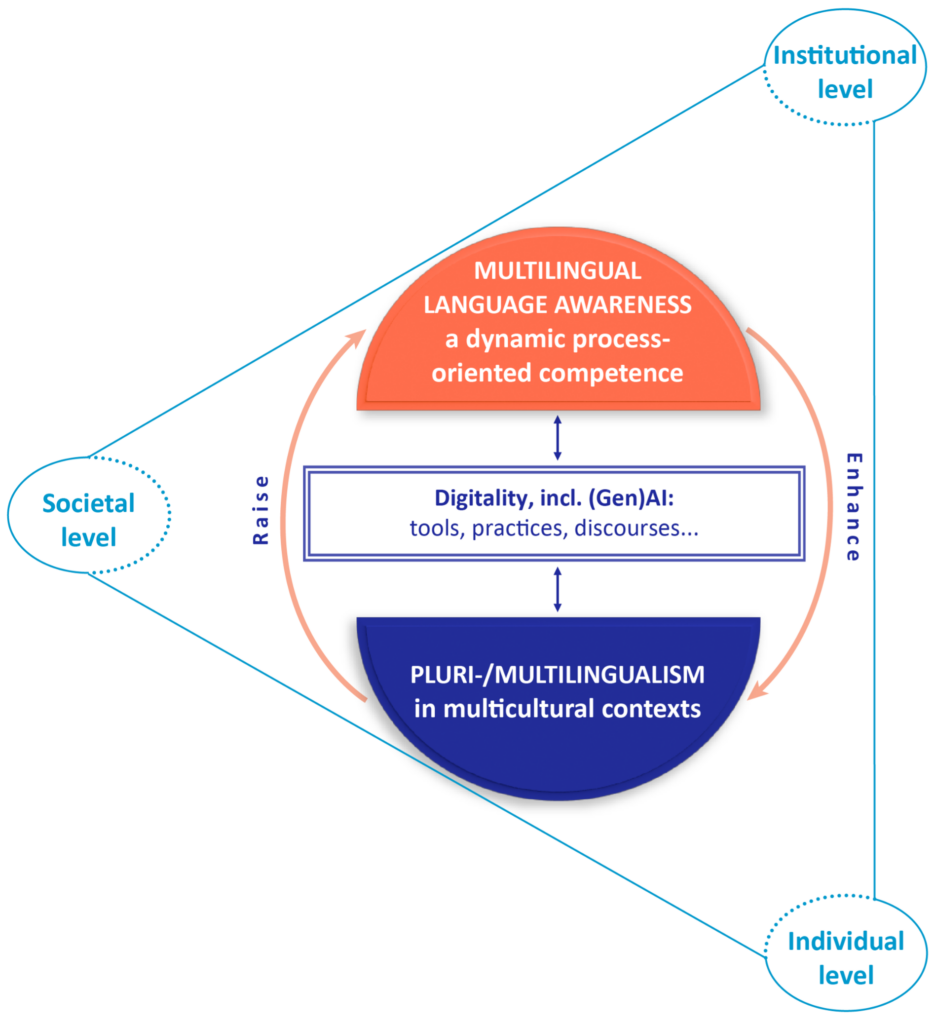
1) Language Awareness and pluri-/multilingualism are closely linked4. In a context of linguistic diversity, Language Awareness is an essential, dynamic process-oriented competence for individuals, for institutions and for societies that contributes to raise the individual’s plurilingual repertoire, and vice versa: the plurilingual competence contributes to the development of Language Awareness.
2) There is a close link between digitality, Language Awareness and pluri-/multilingualism: Digitality, e.g. social media, digital resources / data / corpora / infrastructures, online dictionaries & glossaries, digital discourses and practises as well as AI technologies in general, can contribute to raise LA and in turn, enhance pluri-/multilingualism.
MultiLAwa’s research programme is grounded in two key operational Language Awareness’ frameworks: i) in James / Garrett’s (1998 a/b) model5, which identifies five interdependent domains of Language Awareness: the affective, social, power, cognitive and performance domains, ii) in a well-established three-part categorisation of Language Awareness as outlined in research (e.g. van Lier 2004, Daryai-Hansen et al. 2024, Krogager Andersen 20246) : (a) Practical Language Awareness (linked to the performance domain), (b) Metalinguistic Awareness (linked to the cognitive domain), and (c) Critical Language Awareness (linked to the power domain of Language Awareness).
Together, these frameworks form the basis for the overall doctoral research programme, which draws on previous studies focusing on Language Awareness in multilingual contexts and recent developments in Critical Multilingual Language Awareness. MultiLAwa puts forward the concept of Multilingual Language Awareness as it investigates Language Awareness in multilingual contexts, zooming in on Critical Language Awareness, Metalinguistic Awareness and Practical Language Awareness. It takes a broad view of Language Awareness, i.e. not limited to language education, but as a general, socially embedded competence, in order to address major language-related challenges in a rapidly digitalising society and to contribute to sustainable, inclusive and pluri-/multilingual ecosystems across Europe.
1 Cf. e.g. Policy Primer – The AI Language Gap. Considerations on the Multilingual Capabilities of AI Language Models, published by the Cohere Labs team, 2024. See also Zhao, J. et al. 2017. Men Also Like Shopping: Reducing Gender Bias Amplification using Corpus-level Constraints. In Proceedings of the 2017 Conference on Empirical Methods in Natural Language Processing. Association for Computational Linguistics, 2979–2989; UNESCO, IRCAI, 2024. Challenging systematic prejudices: an Investigation into Gender Bias in Large Language Models.
2 “Plurilingualism” and “Multilingualism” have often been presented separately in the past, according to several different theories and approaches, the concept of multilingualism has even tended to supplant that of plurilingualism. In the Council of Europe’s Recommendation CM/Rec(2022)1, The importance of plurilingual and intercultural education for democratic culture (p. 12), plurilingualism is defined as “the potential and/or actual ability to use several languages to varying levels of proficiency and for different purposes”, while multilingualism “refers to the presence of two or more languages in a community or society”. See also the CoE’s Common European Framework of Reference for Languages (CEFR, updated in 2020, p. 31). As pointed out in A Guide to Action-oriented, Plurilingual and Intercultural Education published by a CEFR Expert Group in 2023 (CoE Publishing), it is necessary to move beyond a separate view, as the two concepts cannot, in linguistic and societal reality, be considered as strictly separate from one another. By adopting this approach in MultiLAwa, we are “go[ing] beyond the rather simplistic dualism of the understanding of the difference between plurilingualism and multilingualism […] (plurilingual for persons; multilingual for societies), showing that the issue is more complex than that” (p. 30). Thus, plurilingual developments also can concern the societal level.
3 Hawkins, E., 1984. Awareness of Language: An Introduction. Cambridge University Press; Donmall, B. G. (ed.), 1985. Language Awareness: NCLE Reports and Papers, 6. CILT.
4 See among others, Cenoz, J., et al. (eds.), 2017. Language Awareness and Multilingualism. Springer.
5 James, C. / Garrett, P., 1998a. The scope of Language Awareness. In: James, C. / Garret, P. (1998) (eds), Language awareness in the classroom. Longmann Group, 3-20; James, C. / Garrett, P., 1998b. Language Awareness. A way ahead. In: James, C. / Garret, P., 1998 (eds), 306-318.
6 Van Lier, L. 2004. The ecology and semiotics of language learning: A sociocultural perspective. Kluwer Academic; Daryai-Hansen, P. et al., 2024. Conceptualizing Students’ Language Awareness across Educational Levels in the Context of Plurilingual Education. In: Language Awareness, 550-569; Krogager Andersen, L., 2024. Unfolding Language Awareness in a Plurilingual Context. A study of metalinguistic, practical, and critical language awareness. In: Modern Language Journal, 108(1), 353-380.