Overview – Project description
Today’s European society faces major challenges with far-reaching implications driven by rapid digital transformation and increased mobility, such as linguistic inequality in education, the lack of linguistic diversity in academia, business and governance, the widening technology gap between well-resourced languages and less-resourced languages, biases and stereotyped language (e.g. related to gender, race) conveyed by digital tools and AI technologies. These alarming developments call for urgent action.
MultiLAwa advances pluri-/multilingualism as a key driver of social cohesion and inclusion by promoting Language Awareness (LA) – the explicit and implicit knowledge of language(s) and language use – across individual, institutional and societal levels.
Going far beyond existing research and doctoral training initiatives, the project’s overarching objective is to analyse the interconnections between LA, pluri-/multilingualism and digital transformation, and to translate this knowledge into practical solutions by:
– investigating how LA can serve as a competence for navigating Europe’s digital transition, and how digital progress can foster LA and pluri-/multilingualism;
– developing new theoretical, methodological and empirical foundations for LA in the digital age;
– creating innovative digital resources and guidelines to raise LA and thus enhance pluri-/multilingualism.
Bridging the gap between academia and industry, MultiLAwa brings together 10 European universities and 15 associated partners (including 10 non-academic organisations) in an exceptional multi-stakeholder consortium. MultiLAwa will train a new generation of 14 young plurilingual researchers to become experts capable of addressing language-related challenges in a rapidly digitalising society – contributing to sustainable, inclusive and pluri-/multilingual ecosystems across Europe.
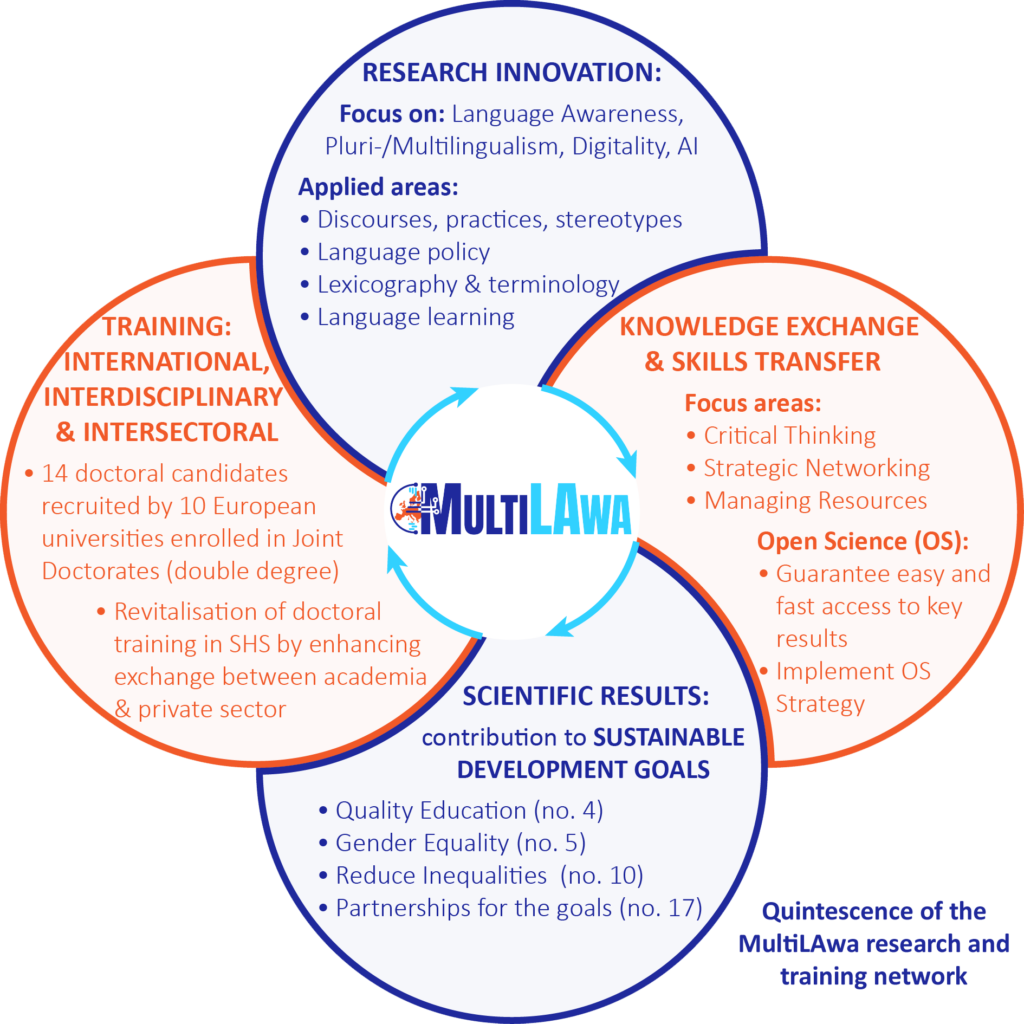
MultiLAwa research and training programme fully fit in the Social Sciences & Humanities panel (main focus on: Linguistics – Use of language + Comparative linguistics, – Education): the consortium gathers beneficiaries and Associated Partners with profound expertise in various linguistic, educational and sociological approaches and skills from complementary subdisciplines – first of all: (Applied) Linguistics, Digital Linguistics & Language Technologies (AI, NLP, Computational Linguistics), Gender Linguistics, Interactional Linguistics, Sociolinguistics, Lexicography, Terminology, LSP, Didactics and Language Policy. The research programme will also integrate expertise data, techniques, tools, concepts and theories from other scientific disciplines, in line with the targeted stakeholders of MultiLAwa’s key exploitable results: Economic Sciences (Finance), Information Science and Engineering (AI and Multimedia), Environmental and Geosciences (Circular Economy). This interdisciplinary approach is unique and unprecedented in doctoral programme in Europe.