Partners index by country
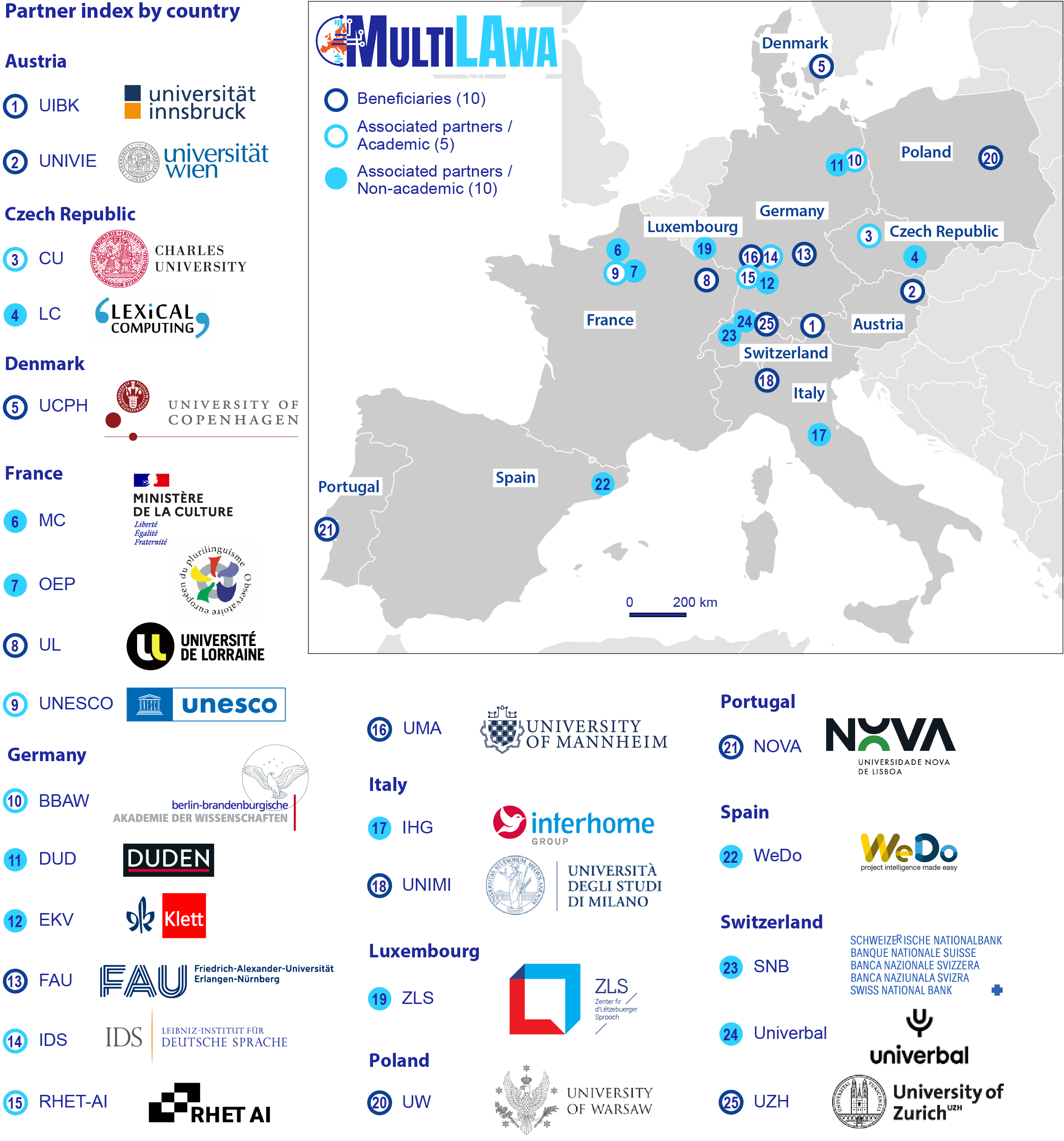
Beneficiaries
B1 – Université de Lorraine : Prof. Alex Boulton, Prof. Hélène Vinckel-Roisin (Coord.)
B2 – University of Innsbruck: Prof. Laura Giacomini
B3 – University of Vienna: Prof. Eva Vetter
B4 – Friedrich-Alexander Universität Erlangen-Nürnberg : Prof. Ludwig Fesenmeier, Prof. Stefan Schierholz
B5 – University of Mannheim: Prof. Henning Lobin, Prof. Johannes Müller-Lancé, Prof. Florence Oloff
B6 – University of Copenhagen: Dr. Lars Behnke, Prof. Petra Daryai-Hansen, Assoc. Prof. Mirjam Schmuck
B7 – University of Milan: Prof. Carolina Flinz (Milan/Pavia), Prof. Fabio Mollica
B8 – University of Warsaw: Prof. Ewa Żebrowska
B9 – Nova University Lisbon: Prof. Rute Costa
B10 – University of Zurich : Prof. Noah Bubenhofer
Associated Partners
AP1 – Charles University : Dr. Vitek Dovalil
AP2 – Lexical Computing : Ondřej Matuška
AP3 – Leibniz Institute for German Language: Prof. Andreas Witt, Prof. Angelika Wöllstein
AP4 – Berlin-Brandenburg Academy of Sciences and Humanities: Dr. Lothar Lemnitzer
AP5 – Center for Rhetorical Science Communication Research on Artificial Intelligence : Prof. Annette Leßmöllmann
AP6 – Dudenredaktion Cornelsen Verlag GmbH : Dr. Laura Neuhaus
AP7 – Ernst Klett Verlag GmbH : Petra Bauersfeld
AP8 – WeDo – Project intelligence made easy: Mireia Manent, Ángel Honrado
AP9 – United Nations Educational, Scientific and Cultural Organization: David Castillo Perra, Dr. Xianhong Hu
AP10 – Ministère de la Culture, Délégation générale à la langue française et aux langues de France : Priscilla Gustave-Perron
AP11 – Observatoire européen du plurilinguisme : Prof. Isabelle Mordellet-Roggenbuck, Prof. Jean-Marc Delagneau
AP12 – Interhome Group : Filippo Boschi
AP13 – Zenter fir d’Lëtzebuerger Sprooch : Dr. Sara Martin, Dr. Sarah Muller
AP14 – Univerbal : Samuel Bissegger
AP15 – Swiss National Bank : Stéphane Carsenty
List of participants
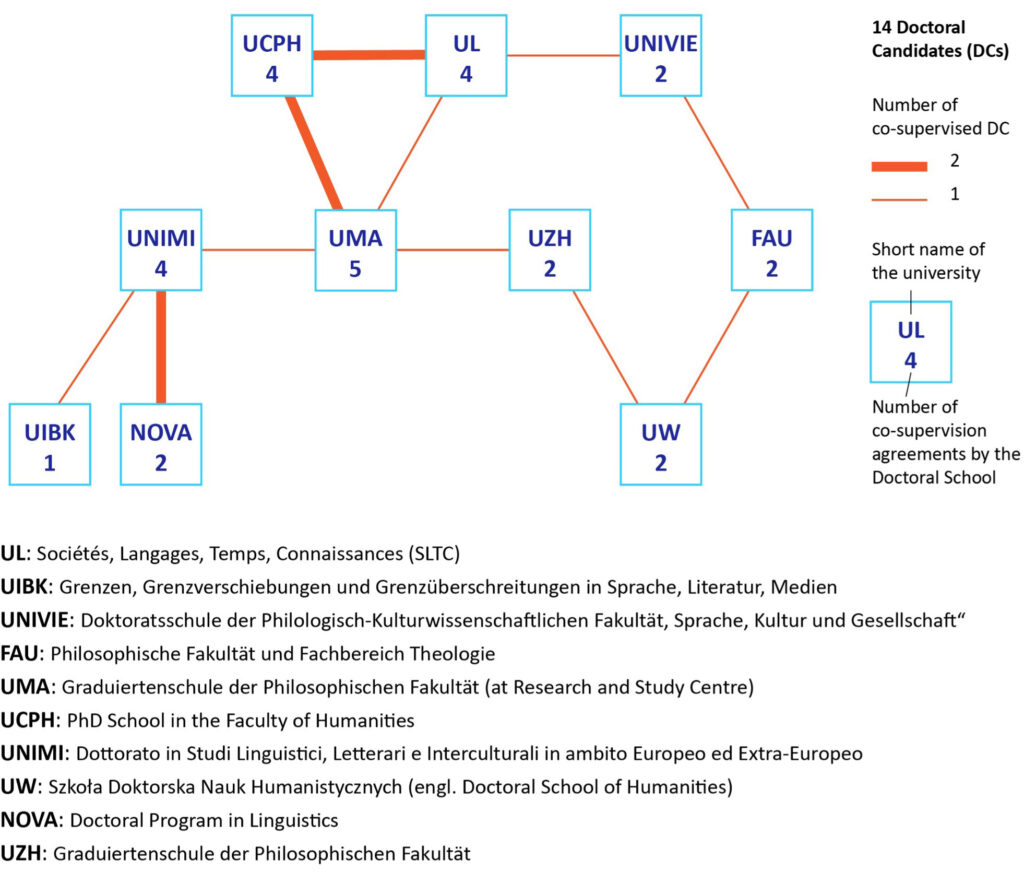
Network of 10 Doctoral Schools